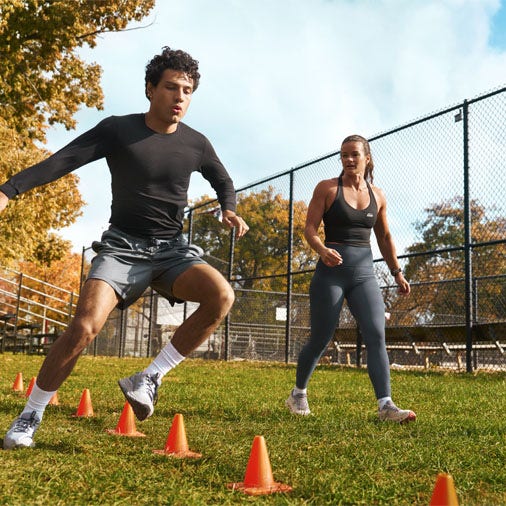
Every four years, soccer's biggest moment puts elite movement on full display: explosive sprints, rapid deceleration, controlled cuts, and seamless transitions between positions. During the opening week, your clients are subconsciously studying how elite athletes move. That creates a powerful opportunity.
As a personal trainer, you can turn what they’re seeing on the pitch into something they can feel in their body. Those fluid transitions from control to power don’t start during the match—they’re primed in the warm-up.

Heather Cherry
NBC-HWC, IC-FHS, CPT, NTP, Content Strategist
The Warm-Up Value
Watch the first five minutes of any match, and you’ll see players accelerate, decelerate, change direction, and regain balance in fractions of a second. What looks effortless is actually the result of structured preparation.
A structured warm-up sets the tone for how clients will move, how efficiently they produce force, and how well they control that movement under load.
At its core, a warm-up serves three primary functions:
- Increase tissue temperature to improve elasticity and readiness.
- Improve joint mobility to access proper ranges of motion.
- Activate the nervous system to prepare for coordination, speed, and force production.
Soccer-inspired warm-ups give you a system to help clients:
- Build movement awareness.
- Improve coordination and control.
- Transition into exercise with intention.
Try this: Think about your next client session. Are they truly prepared to control movement under speed, or just warm enough to start sweating?
What Soccer Gets Right
On the field, soccer warm-ups are progressive and purpose driven. Players build toward sprinting with strategy, including:
- Gradually layering in speed and intensity.
- Opening range of motion.
- Reinforcing movement patterns.
You see this progression live in matches. Early touches are controlled; movement expands, and only then does the pace fully open. That same structure is what makes soccer-inspired warm-ups so transferable to general fitness clients.
FIFA Warm-Up Routine
One of the most widely adopted warm-ups and soccer mobility exercises is the FIFA 11+, a structured, 20-minute routine built around movement quality. It combines controlled running drills, strength work, balance training, and progressive speed development to reflect how players move on the field.
Rather than jumping straight into intensity, the FIFA warm-up routine reinforces proper mechanics during actions like sprinting, cutting, and landing. The result is improved stability, more efficient movement, and reduced dysfunctions—particularly in the knees and ankles.
While personal trainers don’t need to replicate this pre-game warm-up exactly, it highlights a key principle: Warm-ups are most effective when they follow a clear progression from controlled movement into dynamic output.
The 10-Minute Soccer-Inspired Warm-Up Sequence
Structure the first 10 minutes of your session like a match build-up:
Restore → Refine → React
Phase 1: Restore Movement (Mobility)
Before players sprint or cut, they need access to range of motion—especially in the ankles, hips, and thoracic spine. Without it, you’ll see compensations like faulty foot and knee mechanics, limited control when cutting or changing direction, and an inefficient gate.
Over time, compensations reduce efficiency and increase stress on surrounding joints. Improving mobility early in the session gives clients access to positions they may otherwise avoid.
Instead of long static holds, this phase of the soccer-inspired routine prioritizes controlled, active movement at end ranges. This teaches the body not just to reach a position, but to stabilize it.
Applied drills
Keep the pace slow and intentional. The goal is to control each position, not move quickly through it:
- Ankle Rocks: Improves dorsiflexion for sprint mechanics and deceleration.
- Hip Circles: Builds strength at end range for cutting and rotation.
- World’s Greatest Stretch: Integrates hip drive with torso rotation (just like turning upfield).
Watch for this in matches: Clean first touches and sharp directional changes depend on this exact mobility.
Phase 2: Refine Movement (Coordination)
This is where mobility becomes usable. On the pitch, this shows up as controlled dribbling, positioning, and balance before a pass or change of direction. With clients, the goal is to connect movement across planes while maintaining stability.
This phase introduces controlled deceleration, which is often undertrained but essential for joint health and stability.
Applied drills
Layer movements and lower-body mechanics with rotation, lateral motion, and tempo changes, but encourage control before progression. Clients should demonstrate stability in each position before increasing speed or complexity:
- High Knees → March Transition: Teaches speed and positional control.
- Inchworms: Reinforces posterior chain and hinge pattern.
- Lateral Shuffle with Pause: Mimics defensive slides and controlled stops.
- Walking Lunges with Rotation: Integrates lower body + torso (like scanning the field while moving).
Try this: Can your client pause and hold alignment after movement, or do they immediately lose control?
Phase 3: React + Activate (Neural Prep)
Neural activation prepares the nervous system to produce faster, more coordinated movement. It involves quick transitions, reaction elements, and controlled bursts of power. It also builds confidence when clients begin moving at higher speeds.
This phase layers in the qualities that define match play like quick reactions, acceleration, and controlled power.
Applied drills
Emphasize light, controlled movement. Speed should be built naturally, not at the expense of positioning. Now, the warm-up becomes performance-prep:
- Acceleration Builds: Develops sprint mechanics progressively.
- Quick Feet → Athletic Drop: Produces reactive stability under speed.
- Skater Jumps: Improves lateral power and single-leg control (mirrors defensive recovery and cutting)
Watch for this in matches: Every successful cut, sprint, or recovery run depends on this ability to produce and control force quickly.
Coaching It Like A Pro
The best coaches don’t overload cueing but do sharpen intent. Clear, focused cues help clients connect mobility and movement into something they can use during training. The goal is to guide how a movement feels and functions, including:
- Absorb force with balance and stability.
- Control positions before increasing speed.
- Maintain alignment through the torso and lower body.
- Move with intention rather than rushing through reps.
Modifying for Older or Beginner Clients
Not every client is match-ready, and that’s the point. For beginners or older clients the structure stays the same. But the execution meets the client where they are, including:
- Building confidence in each phase before progressing.
- Reducing complexity, not purpose.
- Slowing tempo before adding speed.
Turn This Warm-Up into a System
Soccer-inspired warm-ups work because they follow a system. They teach clients how to access movement, control it, and apply it under demand.
Build a movement foundation your clients feel in every session. Become a National Academy of Sports Medicine (NASM) Certified Personal Trainer. Then expand into speed, agility, and performance development with Performance Enhancement Specialization.
Soccer-Inspired Warm-Up Drills: Key Questions Personal Trainers Are Asking
Turn your next warm-up into something more intentional and watch how quickly your client’s movement improves. Want to go deeper? Here are answers to the most common questions personal trainers are asking right now.
How Long Should a Soccer-Inspired Warm-Up Be?
A well-structured warm-up typically lasts between 8 to 12 minutes, with enough time to move through dynamic mobility for soccer-inspired movement preparation and activation without rushing any phase.
Can Soccer Warm-Up Drills Be Used for General Fitness Clients?
Soccer-style warm-ups translate well to general fitness settings since they focus on fundamental movement patterns like rotation, acceleration, and balance, all of which apply beyond sport-specific training.
What Makes a Soccer Warm-Up More Effective Than Traditional Approaches?
Effective warm-ups follow a progression that prepares joints, reinforces movement patterns, and gradually introduces intensity, rather than relying only on passive stretching or light cardio.
Are Soccer Warm-Up Drills Suitable for Beginners?
Soccer-inspired warm-up drills can be adapted for beginners by adjusting speed, range of motion, and complexity, allowing clients to build control before progressing into more dynamic movement.
When Should Personal Trainers Use This Type of Warm-Up?
Soccer-inspired warm-ups work well before sessions that include lower-body strength work, conditioning, or any movement involving direction change or coordination.
What Is the Most Common Warm-Up Mistake Personal Trainers Make?
Skipping progression and moving directly into intensity often limits how well clients move during the workout and reduces the overall effectiveness of the session.