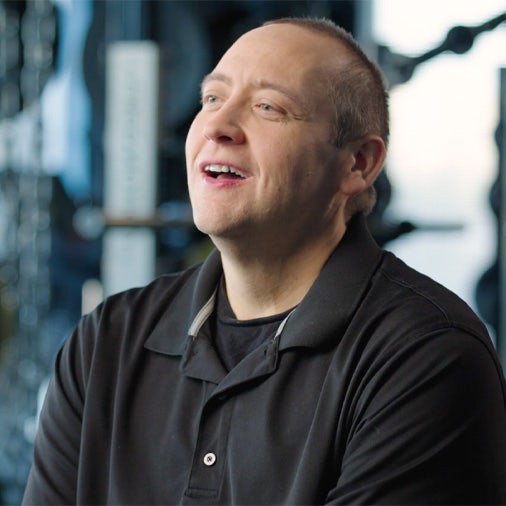
Three and a half years ago, Jamie Selzler weighed 652 pounds. Today, he hikes 12 to 14 miles at a time, coaches clients, and is a National Academy of Sports Medicine (NASM) Certified Personal Trainer, Certified Nutrition Coach, and Certified Wellness Coach.
The transformation is dramatic, but it didn’t begin with motivation or even a plan. It began with an unexpected moment—alone in his apartment, unable to stand up from the toilet. “I was not strong enough to stand up. And in that moment, I just had terror,” he said.

Heather Cherry
NBC-HWC, IC-FHS, CPT, NTP, Content Strategist
“I wasn’t scared I was going to die right then,” he added. “But it made me think—what happens if something like this is the end? How is anyone going to get me onto a gurney?”
He confronted something he avoided for years: not just mortality, but the quality of the years ahead. “I realized I wasn’t going to live very long,” he said. “But my worst case wasn’t death. My worst case was that the life I had left was going to be hard and sad.”
At the time, Selzler was 43, increasingly immobile, and running out of margin. “I think I was about six months away from complete immobility,” he said. “And that’s when I started to make changes.”
Now, having lost more than 370 pounds and become a personal trainer, he’s building a life that looks almost unrecognizable.
For personal trainers, his story offers more than inspiration. It offers a look at what meaningful change requires for people living in larger bodies, and why the rise of tools like GLP-1 medications, rather than posing a threat to the profession, may signal a turning point.
What It Actually Feels Like
Selzler lived in a larger body for most of his life—over 500 pounds since his early 20s—but the experience went deeper than weight. It showed up in how he moved through the world, what he avoided, and eventually, what he stopped believing was possible.
The limits built slowly. Walking short distances became exhausting. Outings required planning. Even routine activities carried a cost most people never think about. “When you’re that size, a shower is cardio,” he said. “You break a sweat in the shower. After the shower, you have to lay down and recover.”
There’s a tendency, especially in fitness spaces, to reduce obesity to a simple formula: eat less, move more, and be more disciplined. Selzler’s experience shows something more complex. As movement became harder, his world got smaller. And as his world got smaller, he moved even less. “There are things that you would like to do, places you would like to go,” he said. “And your body just won’t let you.”
Eventually, he stopped testing those limits.
The Accumulation of Wake-Up Calls
The bathroom moment wasn’t the first sign things were getting worse. The introduction of a walker gave him mobility, but it came with its own cost. “I didn’t want to leave my house with it,” he said. “So I just didn’t go out anymore.”
Isolation crept in, and invitations turned into polite declines. He told himself his friends didn’t notice. They did. The next time he saw them, one by one, they pulled him aside. Each had the same message in their own words: they were worried.
One conversation stayed with him. “A friend of mine who’s 75 said, ‘I want you to go to my funeral. I don’t want to go to yours,” Selzler said.
He couldn’t unhear it.
Not Motivation. Momentum.
The first changes were small enough to miss. “You don’t have to change everything at once,” Selzler said. “My first change was I drank a glass of water every time I went to the bathroom.”
And then another change. And another. Over time, those small actions began to stack. As his body responded, his capacity expanded. What once felt impossible started to shift. “I would walk 20 feet, then 25, then 50,” he said.
That progression eventually led to 12- and 14-mile hikes. But in the beginning, progress was measured in feet, not miles. “It’s better to be consistently good than sporadically perfect,” Selzler said.
The Tool That Changed Everything
For most of his life, Selzler tried to lose weight. Like many people, he experienced periods of success, losing 100 pounds or more, only to regain it. The missing piece wasn’t effort. It was harder to see.
He calls it “food noise,” a constant mental pull toward food that has nothing to do with physical hunger. It shows up as a running dialogue—what to eat next, whether to eat again, even when he’s just eaten. “It’s like there’s a voice in your head that just doesn’t stop,” he said. “It keeps pushing.”
For years, he tried to fight it with willpower. Sometimes he won temporarily. Eventually, he always lost. “You can only fight that for so long,” he said.
He considered a GLP-1 medication, but hesitated. “It was part fear and part ego,” he said. “I thought I should be able to do it on my own."
After years of cycling through the same pattern, he made a different decision. He talked with a physician and started the medication. For him, the impact was immediate in a different way. The mental pressure eased. “It quieted the food noise,” he said. “It let me make better decisions.”
That shift didn’t do the work for him. It made the work possible. It created space to follow through—to move more, eat differently, and stay consistent.
What Personal Trainers Are Missing
As GLP-1 medications have become more visible, many personal trainers have responded with hesitation or skepticism. Selzler sees something different. “There has never been a better business opportunity for personal trainers than GLP-1 medication,” he said. “People aren’t looking for shortcuts. They want something that finally works. For many of them, this is the last straw.”
When it works, something changes. The food noise quiets. The weight begins to come down. For the first time, progress feels possible. “They need support,” he said. “They need to understand how to move, how to build habits, and how to sustain it.”
In other words, they need coaching.
Most personal trainers were never educated on how to work with clients using medications like these. But as more clients walk in already using GLP-1s, that gap is getting harder to ignore.
What Good Coaching Feels Like
Selzler’s view of coaching was shaped long before he became NASM certified. He had worked with personal trainers before—some effective, some less so—but the difference came to empathy. “He found things for me to do that aligned with my strengths,” Selzler said of this trainer. “And he understood the stakes. For someone in a larger body, injury isn’t a minor setback. It can be life-altering.”
That experience reshaped how he thinks about personal training. “A good trainer respects that,” he said. “And more than anything, a good personal trainer provides reinforcement.”
Pride, Reframed
As Selzler’s transformation became visible, people began reaching out. Friends, then followers, then strangers—not just congratulate him but ask how he did it.
At first, he shared what had worked for him. But that quickly felt incomplete. “I wanted to help people from a place of education, not just best effort,” he said.
He chose to formalize what had started informally, earning certifications in personal training, nutrition, and wellness. Not for credibility alone, but for responsibility.
What stands out is how he talks about pride. “I’ve lost 370 pounds,” he said. “But I don’t feel pride about that. I feel grateful.”
The pride shows up somewhere else. “I’m proud that I became a certified personal trainer,” he said. “Because I had to work for that.”
A Life That Feels Different
Today, Selzler’s life isn’t defined by dramatic milestones, but by the absence of the barriers that once shaped everything. “My life is better in every single way,” he said.
He doesn’t carry shame for who he was. “I have no hatred for my 650-pound self,” he said. “That’s why I’m here today.”
That perspective carries into how he works with clients, and how he believes coaches should approach their role. Not as fixers or judges. As guides. Because real change, the kind that lasts, rarely looks dramatic while it’s happening.
For Selzler, the message is simple. “You don’t have to change everything,” he said. “Just pick one thing. And then do it again tomorrow.”