Rubber and Iron and Steel, Oh My! Here are the Best Weight Plates in 2022
We test and review fitness products based on an independent, multi-point methodology. If you use our links to purchase something, we may earn a commission. Read our disclosures.
Table of Contents
- Best Rubber Weight Plates (Best Bumper Plates): Fringe Sport Black Bumper Plates
- Best Cast Iron Weight Plates: REP Fitness Iron Plates
- Best Weight Plates for Powerlifting: Rogue Fitness Calibrated KG Steel Plates
- Best Weight Plates on Amazon: CAP Barbell Olympic Grip Plates
- Best Budget Weight Plates: Hi-Temp Bumper Plates
- Best Weight Plates With Handles: Titan Fitness LB Black Grip Plates
- Best Steel Weight Plates: Synergee Standard Metal Weight Plates
- How We Tested and Chose the Best Weight Plates
- Benefits of Weight Plates
- What to Look for in Weight Plates
- Traditional Weight Plates vs. Bumper Plates
- FAQs
Best Weight Plates in 2022
There’s no feeling quite like slinging around a barbell. Not literally, of course, but figuratively: When the barbell feels good and the plates are staying put and you feel like you could move a mountain. Man, that’s a good feeling! And having the best weight plates for your sport or activity is a huge factor in achieving that feeling—and in generally having enjoyable workout sessions. Ahead are our top picks for the best weight plates in all categories.
Best Rubber Weight Plates (Best Bumper Plates):
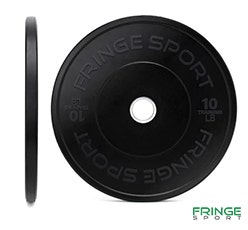
Fringe Sport Black Bumper Plates
These simple but durable bumper plates are the best value for most home gym owners.
Fringe Sport Black Bumper Plates Specifications
Pros:
- Minimal bounce
- High durometer rating
- Hooked stainless steel inserts
Cons:
- 10s have smaller diameter (17.5”)
- Greasy out of the box
- May have a strong rubber smell
When a pair of bumper plates is warrantied against dropping them, you know they’ll be good. These Fringe Sport bumper plates come in pairs or sets and are available as 10s, 15s, 25s, 35s, 45s, and 55s. All of them—even the 10s, which is a big deal—are warrantied against dropping them while on a barbell. This is thanks largely to the high Shore A durometer rating of 85 on everything but the 10s and 15s, which have a rating of 90. The higher the rating, the more durable (and less bouncy) the plates are.
Additionally, these bumpers feature hooked stainless steel inserts so they won’t come loose or corrode. The 50.4-millimeter collar opening will snugly hug 2-inch barbell sleeves. Our minor gripes with these plates are that they have a strong rubber odor coming out of the box (but it will fade) and that the 10s have a slightly smaller diameter compared to the rest of the plates.
Best Cast Iron Weight Plates:
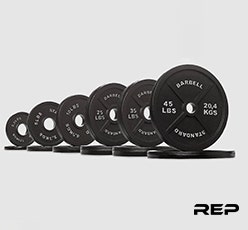
REP Fitness Iron Plates
For the budget-minded, cast iron plates are the economical choice. Plus, these have an old-school vintage look.
REP Fitness Iron Plates Specifications
Pros:
- Available in pairs or in sets
- Deep lip makes them easy to pick up
- Thin width means you can fit a lot of weight on the bar
Cons:
- 3% weight tolerance
- Paint may chip over time
- Each weight has a different diameter
I love these REP Fitness Iron Plates for their classic aesthetic and lipped design that makes them easy to pick up from the ground. (Anyone who’s tried to pick up an unbeveled 45 pound plate from the floor knows how hard it is). Coated with a matte finish and raised silver lettering, these will make a good addition to the home gyms of recreational powerlifters and bodybuilders.
Although there’s a stated weight tolerance of 3% (defined as how much the weight is allowed to deviate from the stated weight), many customer reviews indicate that the weight plates have a tighter tolerance than that. Finally, you should know that cast iron weight plates (and any metal plates) don’t have the same diameters across weights. For example, the 45 pound plate has a diameter of 17.7 inches and the 35 pound plate has a diameter of 14.3 inches. This isn’t necessarily a bad thing, but it is something to be aware of.
Best Weight Plates for Powerlifting:
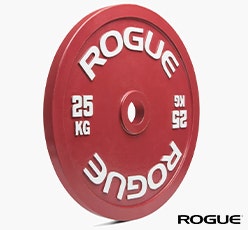
Rogue Fitness Calibrated KG Steel Plates
Rogue is known for making the best of the best, and these plates are no different: Calibrated to precision, these ultra-thin plates allow you to stack loads onto your barbell.
Rogue Fitness Calibrated KG Steel Plates Specifications
5 kg: 228 mm; 2.5kg: 190 mm
Pros:
- Precision-machined for accuracy
- Thin width allows for optimal loading
- 50 mm center hole stays snug on barbell sleeve
Cons:
- Come in kilograms, so may take some getting used to
- Expensive
- 50 mm collar may not fit on barbells that aren’t to IPF or IWF specs
If you compete in powerlifting, these are the weight plates you want. Designed to meet the specifications of the International Powerlifting Federation (IPF), the Rogue Fitness Calibrated Steel Weight Plates are machined to precision and have a weight tolerance of just 10 grams. The thin width allows for a 700 pound loading capacity on a standard Olympic barbell. These are also available as fractional plates, which are teensy plates that competitive lifters can use to increase their max lifts in small increments.
Because they feature a 50 millimeter collar, these plates may not fit on barbells that don’t meet the specifications of the IPF or International Weightlifting Federation (IWF), which means a 2 inch sleeve. Additionally, they are very expensive, starting at $31 for a 0.25 kilogram pair and skyrocketing to more than $300 for a 25 kilogram pair. But, they’ll be more than worth it for competitive powerlifters.
Best Weight Plates on Amazon:
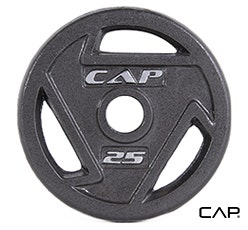
CAP Barbell Olympic Grip Plates
If you want free Prime shipping and a lot of bang for your buck, these Olympic weight plates will get the job done.
CAP Barbell Olympic Grip Plates Specifications
Pros:
- Available in pairs and singles
- Design makes them easy to grip and load
- Fits all Olympic barbells
Cons:
- Enamel coating may chip off
- Weight tolerance not specified
- Diameter of 45s is smaller than standard
Are you a “weight is weight” kind of exerciser? If so, you’ll want to take a gander at these CAP Barbell Olympic Grip Plates. They’re nothing fancy or spectacular, but they come at a great price point and will certainly make your barbell heavier. So, if that’s all you’re after, these are your best bet.
These solid cast iron CAP plates are coated in an enamel finish to protect the cast iron underneath, but in our experience, it starts to chip off after a while. No problem if you’re not afraid of a little rust. While some customer reviews report that the stated weight is inaccurate, we didn’t find that to be the case with our set. We have no major complaints about these budget-friendly plates.
Best Budget Weight Plates
Hi-Temp Bumper Plates
These rubber weight plates are great for anyone who wants classic bumpers for a lower price.
Hi-Temp Bumper Plates Specifications
Pros:
- Less expensive than bumpers made with virgin rubber
- Safer for floors than metal plates
- Durable
Cons:
- Made of recycled rubber, so may smell strong
- High bounce (softer rubber)
- Steel inserts are known to dislodge
If you want bumper plates but don’t want to fork out the cash for those made of virgin rubber, check out Hi-Temp bumper plates, which are made out of recycled rubber. They’re less expensive and eco-conscious—a win-win! Because these are made of crumb rubber, they’re more porous than their new-rubber counterparts. This leads to more bounce, which isn’t a big deal, but can get frustrating if you’re dropping your barbell (the bar will bounce and roll).
These plates are a great option for people who do CrossFit-style workouts that involve lots of overhead and front-rack exercises, since people tend to drop bars from those positions. For what it’s worth, we don’t condone dropping the barbell, but we know it happens—so we’re letting you know which weight plates are best for that.
Best Weight Plates With Handles:
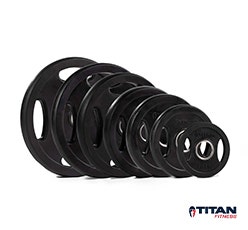
Titan Fitness LB Black Grip Plates
These accurate weight plates are easy to pick up, load onto the bar, unload, and rerack thanks to the handles on each side.
Titan Fitness LB Black Grip Plates Specifications
Pros:
- Handles make them easy to grab
- Available in singles, pairs, and sets
- Rubber-coated for durability
Cons:
- Weight tolerance not noted
- Collar is not stainless steel (may rust)
- Stock fluctuates frequently
Picture this: You’re in the gym. You need your 45-pounder. It’s flat on the ground and no matter what you try, you just can’t get your fingers beneath it to lift it up. This has happened to the best of us, but you can avoid this scenario by choosing weight plates with grips on them, like the Titan Fitness LB Black Grip Plates.
Aside from the handy grips, we like these plates for their durable rubber coating and easy-to-read weight indications. The 450 millimeter diameter and 50.6 millimeter collar are up to snuff, but the fact that the weight tolerance isn’t noted leaves us wondering. Still, after several workouts with these, we find them to feel accurate enough for the recreational lifter. If you plan on storing these in a garage gym (or other non-climate-controlled area), you should know that the inserts aren’t stainless steel and may rust over time.
Best Steel Weight Plates:
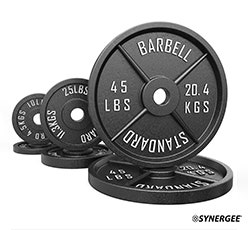
Synergee Standard Metal Weight Plates
For dependable, simple, classic metal weight plates, you can’t go wrong with these steel sets.
Synergee Standard Plates Specifications
Pros:
- Available in singles, pairs, and sets
- Deep lips makes them easy to grab
- Kg and lb markings on each plates
Cons:
- Paint may chip
- Not easy on floors
- Diameter varies by weight
You might look at these and say they’re run-of-the-mill, but I look at them and say they’re simply classic. The slate gray enamel, deep lipped design, and raised silver lettering—with both kilogram and pound markings!—is reminiscent of the glory days of bodybuilding.
Aesthetics aside, these Synergee weight plates have a lot going for them: a 17.5-inch diameter on the 45s; 2-inch collar opening; and availability in singles, pairs, and sets. They have a 3% weight tolerance, which is higher than we like to see (1 to 2% is ideal), but it’s no big deal for recreational lifters.
How We Tested and Chose the Best Weight Plates
Our roster of product testers and fitness professionals includes certified personal trainers, CrossFit L-1 coaches, and athletes of all disciplines. We’ve been slinging barbells around for years, and collectively more than a decade. For each of the products on our top list, there are hours of research, hands-on testing, and workouts behind the scenes.
Benefits of Weight Plates
What’s a home gym without weight plates? Kidding, of course—there are many ways to build a home gym without plates. But, as fitness coaches and strength training enthusiasts, we have to make our case. Here are a few reasons you may want to consider adding weight plates to your home gym.
- Get stronger: It’s no secret that lifting weights makes you stronger. Countless scientific studies report increases in muscle mass and strength during weight training programs.
- Build muscle: Lifting weights is also the best way to build muscle, if that’s something you’re interested in. Challenging your muscles against something heavy breaks down muscle fibers and then, during rest, your body builds back bigger and stronger.
- Versatile workouts: You can do just about anything with weight plates. Sure, you can do all of the big barbell lifts—squats, deadlifts, and pressing variations—but you can also use weight plates on their own. Some exercise ideas include: ground-to-overhead, weighted sit-ups, overhead walking lunges, Russian twists, and (if your plates have handles) swings. Fun!
- Improve body composition: Strength training, in conjunction with a nutritious diet and other healthy lifestyle habits, is key to altering your body composition in a way that will help you meet your goals.
- Overall health: Aesthetics and performance aside, weight plates will enable you to perform strength training that can improve bone density, improve heart health, increase muscular endurance, burn calories, and more.
- Learn new skills: Adding new training equipment to your arsenal allows you to try new things, which is good for physical and mental health.
What to Look for in Weight Plates
Wait up! We know that buying toys for your home gym is fun and exciting, but don’t get carried away and hand over your credit card info before considering these factors. This guide will ensure you buy the best type of weight plates for your gym and activities.
Materials Used in Weight Plates
There are three main materials used in weight plates: rubber, cast iron, and steel.
Rubber weight plates, also called bumper plates, are best in CrossFit-style settings, where barbells may be dropped from hip-high or higher. (We don’t encourage dropping barbells no matter what type of plate you have, but it does happen).
Steel weight plates are typically the most accurate type of weight plate, given that they’re often calibrated to a 1% weight tolerance or less, like the Rogue Fitness Calibrated Steel Weight Plates. This is not always the case, so be sure to double-check the specs.
Cast iron plates are generally least expensive, but they’re also generally the least durable. Cast iron plates are known to chip and even break in half, and the enamel coating often flakes away over time. However, good cast iron plates can still last a long time if cared for properly.
Grip
For easy loading and unloading, opt for weight plates with grips. Bumper plates don’t generally have grips, so if you want to ensure they’ll be easy to pick up (especially from the floor), get bumpers that have a lip around the diameter.
Overall Diameter and Collar Opening
Point blank: If you plan to deadlift, snatch, or clean a barbell, you need weight plates with a 450 millimeter diameter (or super close to it, if you’re not a competitor). This diameter is the standard for both the International Powerlifting Federation (IPF) and International Weightlifting Federation (IWF). If you’re doing any Olympic weightlifting or CrossFit, you’ll want bumper plates with that diameter. For powerlifters, steel plates with a 450 millimeter diameter are best because they leave more space on the barbell sleeves than bumpers.
The collar opening must be about 2 inches in diameter in order to fit on an Olympic barbell, which is any type of barbell with 2 inch sleeves. Anything from 50.4 millimeters to 50.8 millimeters is good. Anything larger may slide around too much on the sleeves.
Traditional Weight Plates vs. Bumper Plates
Bumper plates are rubber weight plates. Any type of metal weight plate can be considered a traditional weight plate. Each type has its pros and cons.
Bumper Plate Pros and Cons
Pros:
- Safer for floors
- Bounce helps with quick lifts
- Ideal for CrossFit and Olympic lifting
- Protects barbell due to bounce
- Usually cheaper than metal plates
- Quieter than metal plates
- All weights in a set usually have the same diameter
Cons:
- Collar often comes dislodged
- Can’t fit as much weight on the bar
- Recycled rubber plates may chip over time
- Some have excessive bounce
Metal Weight Plate Pros and Cons
Pros:
- Can fit more weight on the bar
- Calibration is possible (enhances accuracy)
- Often designed with built-in grips
- Rubber coatings increase durability
- No need for hooked/inserted collars
Cons:
- Different diameters for different weights
- Enamel coatings are known to chip
- Can cause more damage to floors and barbells
- Can’t be dropped from any height
- Noisier than bumpers
FAQS
Who should buy rubber weight plates?
Bumper plates are best for people who do CrossFit and/or Olympic weightlifting. Anyone who tends to drop a barbell from any height should use bumpers to protect the barbell and their floors. Keep in mind that dropping barbells creates some inherent risk to your safety and the status of your equipment.
Are rubber plates and bumper plates the same thing?
Yes, rubber plates and bumper plates refer to the same thing. In fact, some people refer to them as “rubber bumper plates”, although that’s a bit redundant.
Who should use metal weight plates?
Metal weight plates are great for recreational lifters who don’t do exercises that involve dropping the barbell. They’re also ideal for powerlifters, since the thinner width allows for more plates to fit on the barbell sleeve.
Can you deadlift with metal plates?
Certainly! You can deadlift with any type of plate, although we do recommend your 45 pound or 20 kilogram plates have a diameter of 450 millimeters. This is standard and, if your plates sit higher or lower than that, your deadlift start position may be compromised.
Are dumbbells better than a barbell?
Whichever type of equipment will best help you reach your goals is better for you—neither is inherently better than the other. If your goals require you to have access to a full set of Olympic bumper plates and an Olympic bar, then that’s what you should get. However, not everyone will need more than dumbbells to reach their fitness goals.
What kind of weight plates do commercial gyms have?
Commercial gyms typically stock pretty high-quality plate sets, usually of the metal variety. Often, you’ll see metal plates with a urethane coating for ultimate durability in a commercial setting.
What type of weight plates do weightlifters use?
Competition bumper plates are standard for weightlifting plates. We didn’t include any on this list, because most people don’t need them, and they’re very expensive.