Presented by NASM x PennWest University
In elite sports, real work rarely happens under arena lights. Championships are forged in weight rooms before sunrise, in recovery labs long after fans have gone home, and in the countless unseen decisions that prioritize the human body over the highlight reel.
Across the NBA, NFL, and Power 5 NCAA, the professionals driving this work share a common thread: they are grounded in science, fueled by tenacity, and anchored in service.

Heather Cherry
NBC-HWC, IC-FHS, CPT, NTP, Content Strategist
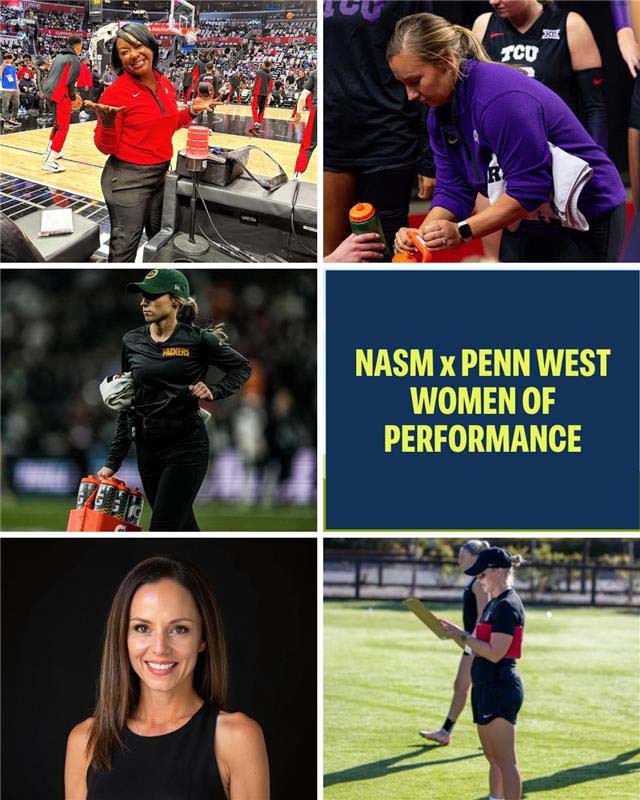
The Women of Performance campaign brings together five leaders whose journeys prove that expertise, compassion, and relentless curiosity can reshape entire organizations. Through the academic–professional partnership of National Academy of Sports Medicine (NASM) and PennWest University, these women transformed learning into competitive advantage—each forging her own path and redefining what leadership looks like at the highest levels of sport.
Elevating Longevity in the NBA
Director of Health and Player Performance at Portland Trail Blazers, Courtney Watson’s influence in the NBA is defined not by the injuries she treats but by the potential she protects. Within an 82–game season marked by constant travel, Courtney has developed systems that help players withstand the marathon.
Her mantra, "The Art of Staying in Your Lane” reflects her belief that elite performance requires a coordinated ecosystem. From culinary to biomechanics, she guides specialists who orbit every athlete, ensuring the individual stays at the center.
Courtney’s turning point came early, when she realized that being undeniable in a male-dominated field required a blueprint of her own. Armed with a Doctorate in Athletic Training, she entered the league prepared to stand out. “My grandmother used to tell me: ‘They can’t take your education away from you,’” she said.
That education—and the confidence it instilled—now fuels the mentorship she offers to hundreds of young women through internship programs.
Innovation is woven into Courtney’s daily work. In Portland, she and her staff are pioneering Circadian Management, leveraging wearables to track sleep and design individualized recovery menus. But beyond the data, it's her presence that grounds the team. As she puts it, “Sometimes these guys need that nurturing care or ‘big sister’ time, but I’m still the one holding them accountable to the standard.”
Grit on the Frozen Tundra
Before she ever stepped onto the field at Lambeau, Erin Roberge, assistant athletic trainer at Green Bay Packers walked into a post office with 32 envelopes—one for every NFL team. At a time when many said the league wasn’t hiring women, Erin mailed her way into an opportunity. That tenacity placed her in Green Bay during the unprecedented 2020 season, where she spent seven months in a COVID “bubble” as a 22-year-old intern, isolated to protect the roster while simultaneously completing her degree.
The experience hardened her resolve. “I knew if I could make it through that year, I could handle anything,” she recalled. Today, Erin is a trusted presence for the Packers, known for her willingness to master the unnoticed but essential tasks that make a performance staff run smoothly. A sign in her office reads: “If you’re too big to do the small things, then you’re too small to do big things.” It’s a philosophy that she lives out daily.
PennWest played a pivotal role in her trajectory. The flexibility of the program allowed her to gain real-time NFL experience while earning her master's degree in exercise science. “In the chaotic world of pro sports,” she said, “that flexibility is the only way to advance.”

Learn the Latest Science in Athlete Performance
Become a Performance Enhancement Specialist
Coaching Through Connection at Stanford
At Stanford, where athletes juggle Division I demand with rigorous academics, performance coaching takes on a unique complexity. Morgan Vetter, assistant director of sports performance at Stanford University, has learned that while technology can enrich training, no device can reveal the emotional state of an athlete. “Technology doesn’t tell you it’s midterms week,” she said.
Morgan practices what she calls radical vulnerability: a willingness to be human first so her athletes can trust her with their goals. Her philosophy is simple but profound. “No one cares how much you know until they know how much you care,” she said.
This approach has proven to be a powerful tool in a male-dominated space, where confidence and authenticity often carry more weight than any certification.
Her advice to those following her path reflects that wisdom. “Be patient, be yourself, and don’t shrink from the sideline just because few women stand there,” she said. “You never know who is watching.”
Tenacity at Texas Christian University and Beyond
For Jordan Tucker, athletic trainer at Texas Christian University (TCU), “hard work” is more than a phrase; it’s a way of life. She completed a two‑year master's degree in just over a year—all while working full-time as an intern in the NFL. The grind was intense, but it laid the foundation for her career today at TCU, where she leads with a blend of discipline and empathy.
Now a new mother, Jordan embodies the possibility of pursuing excellence in both family and profession. She credits her mentor, Ann Wallace, with modeling what balance can look like. “It is possible to be a mother and still remain a successful athletic trainer,” Jordan said.
Her leadership style is rooted in the idea of being a servant leader. As she puts it, “We are a tool that athletes use to optimize their performance. It’s about helping them become the best versions of themselves as athletes and as humans outside of sports.”
Redefining Success Through Assessment
Before she became a nationally recognized educator, Wendy Batts, professor at PennWest and NASM master instructor, stood at a crossroads: pursue physical therapy school or explore a performance model centered on assessment-driven movement. Her choice to follow the latter made her an early challenger of one-size-fits-all training methods and helped spark broader conversations about how women’s bodies should be trained differently.
Wendy brings practical rigor to everything she teaches. Her students are expected to “walk the walk”—recording themselves performing assessments rather than searching for answers online. Each day, she anchors herself with a personal ritual she calls her GPA.
- Setting her Goal
- Defining the Purpose behind it
- Identifying the Action needed
Her work also dispels misconceptions about elite athletes. “People assume pro athletes only need power and intensity,” she explained. “But foundational phases of NASM Optimum Performance Training™ (OPT) model are often what these athletes need most to move well and stay healthy.”
The Throughline of Excellence
Though their environments differ these women share striking commonalities. Science drives their decisions. Authenticity builds their influence. And their willingness to stand confidently in historically male environments is reshaping the performance landscape altogether.
None of these women of performance waited for perfect timing to advance their education. They built careers and degrees in tandem, weaving academic challenges into professional evolution.
The NASM × PennWest partnership provided the structure that empowered their growth.
Why the Penn West x NASM Pathway?
- Elite Flexibility: Designed for the chaotic schedules of the NBA, NFL, and NCAA.
- Evidence-Based Authority: Master the OPT™ model and clinical skills that command respect in any training room.
- Network of Leaders: When you join Penn West, you aren't just a student; you are a peer to the women leading the world’s most elite organizations.
The industry is looking for leaders who are grounded in science and forged in tenacity. Opportunity awaits. Are you ready to be next?
Explore PennWest degree programs.